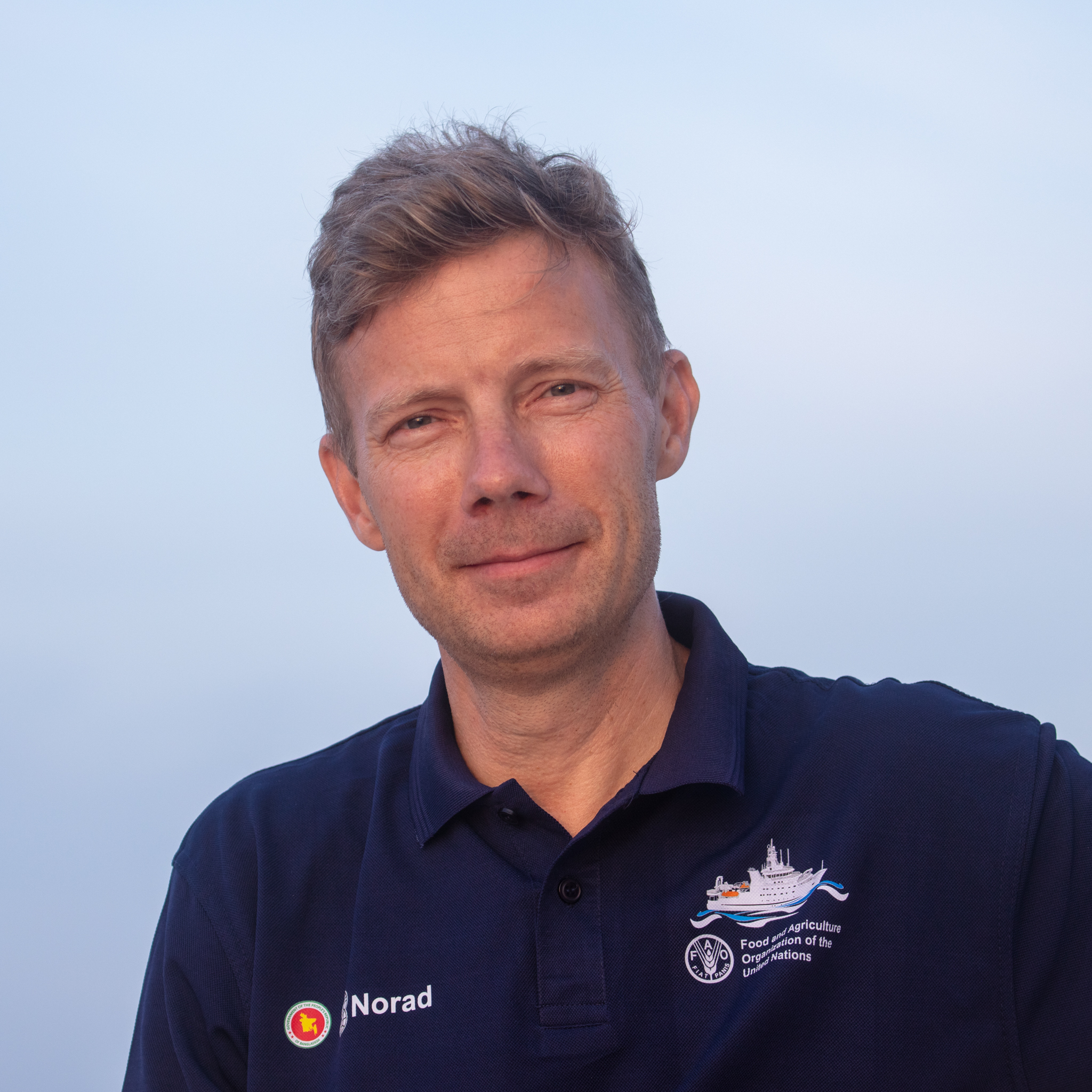
Dr. Erik Olsen leads the Sustainable Development Research Group at the Institute of Marine Research in Bergen, Norway, where he has worked since 1999. Born in Sweden to Norwegian and Swedish parents who spent much of their careers in developing countries, he grew up and was educated in Bergen.
Academic background
Erik holds a BSc in biology (1995), MSc in fisheries biology (1997), and PhD in fisheries biology (2002) from the University of Bergen. His doctoral research developed new methods for age determination in minke whales.
Research and management experience
From 2004-2007, Erik led the joint autumn ecosystem survey in the Barents Sea together with scientists from PINRO in Murmansk — a survey that formed part of the scientific basis for Norway’s ocean management plans. He contributed to developing Norway’s Integrated Management plans from 2002, covering the Barents Sea (2006), Norwegian Sea (2009), and North Sea (2013), and has presented this work to international audiences including the United Nations.
From 2007-2013, he headed the IMR Research Program on Oil and Fish, including work on environmental risk assessments related to petroleum activity in Norwegian sea areas.
In parallel, Erik developed and led several international projects in the Global South. This included marine resource surveys in Mozambique (2009-2010) and Sudan (2012-2013, 2015-2018), as well as sustainable ocean planning (MSP) projects in Mozambique, Kenya, and Vietnam. He also contributed to the 2009 UNESCO guide on marine spatial planning.
From 2009-2013, Erik chaired the ICES Science Committee Steering Group on Human Interactions on the Ecosystem, and co-chaired the ICES Working Group on Integrated Assessment of the North Sea (WGINOSE) from 2017-2021.
As visiting scientist at the NOAA Northeast Fisheries Science Center in Woods Hole, Massachusetts (2013-2015), he worked on ecosystem-based management and marine spatial planning, including applications of the Atlantis ecosystem model.
From 2015-2020, as Head of the IMR Demersal Fish Research Group, he led the Reduced Uncertainty in Stock Assessment initiative.
Current work
Since 2020, Erik has led the Sustainable Development Research Group, with a staff of 20. Current projects include:
- Principal Investigator of the UN Ocean Decade project “ClimeFOOD” (2023-2030), on climate impacts on marine food systems
- Contributor to the EAF Nansen Programme, supporting ecosystem approaches to fisheries in developing countries
- Lead for a Norway-India marine spatial planning collaboration
- Partner with Norad on bilateral projects across the Global South
Publications and recognition
Erik has 46+ peer-reviewed publications (h-index: 31) covering marine mammal biology, ecosystem modeling, and ocean governance. He served on the Norwegian National Committee for the UN Ocean Decade (2021-2025) and co-chaired the UN Ocean Decade Vision 2030 Working Group on “Sustainably Feed the Global Population” (2023-2024).
Research areas:
Capacity building and providing a science based for marine managment in developing countries
Future aquatic food systems
Ecosystem models
Ecosystem-based management (EBM)
Distribution, area use and conservation needs of marine mammals
Oil spill assessments and risk
CONTACT INFO
Erik Olsen
Head of Sustainable Development Research Group, IMR
eriko@imr.no
erik.olsen@protonmail.com encrypted email
Mobile: +47-934 39 256 (NOR)